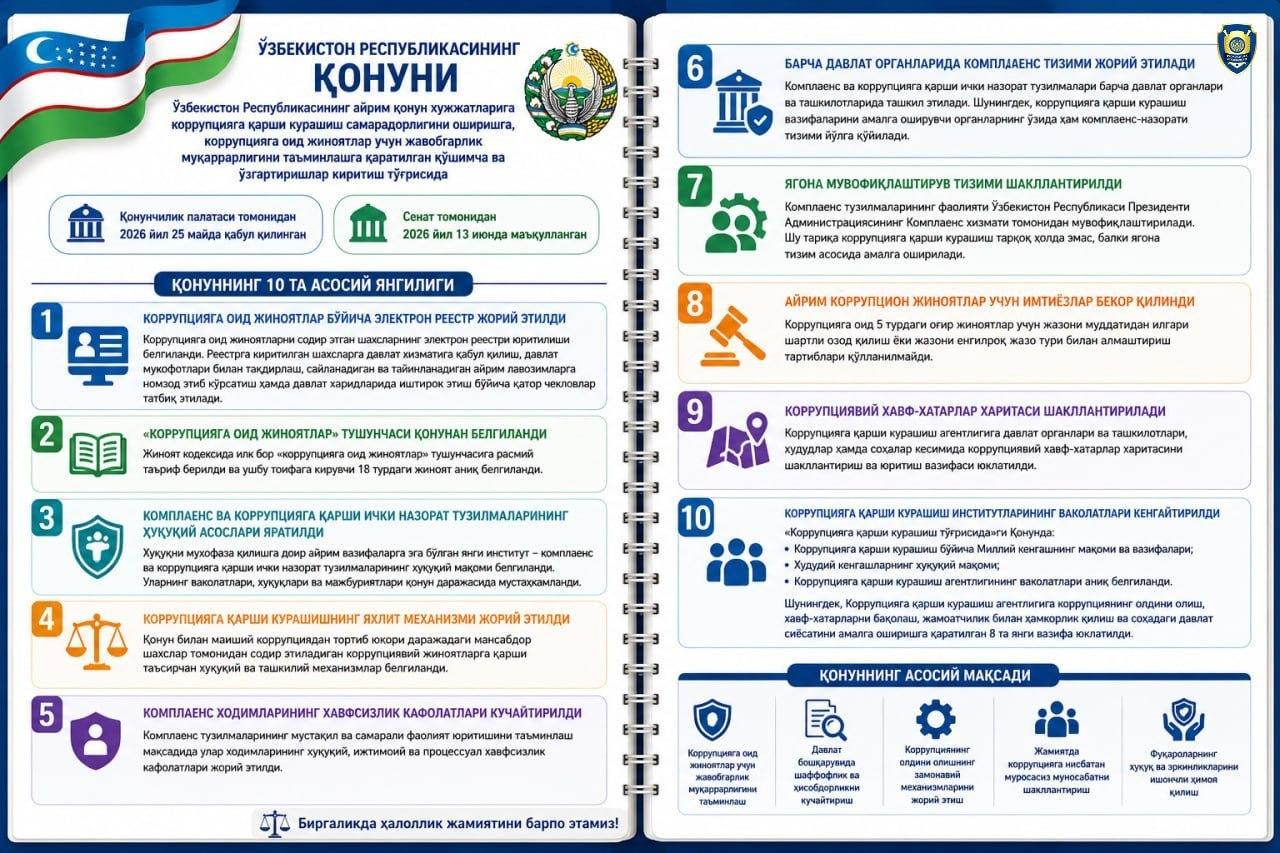
Law No. ZRU-1155, adopted on June 22, 2026, will elevate the mechanisms of accountability, prevention, and institutional control in the field of anti-corruption to a new level.
One of the most important innovations is that a clear list of corruption-related crimes has been established at the legislative level. It includes certain cases of embezzlement and fraud related to the abuse of office or official position, crimes related to bribery, certain official crimes committed out of mercenary motives, and the legalization of income obtained through corruption.
The law introduced an electronic register of persons found guilty of committing corruption-related crimes. For persons included in the register, restrictions are established on entering the civil service, being awarded state awards, being nominated for elected and specially appointed positions, participating in public procurement and public-private partnership projects, as well as holding certain leadership positions during their criminal record.
At the same time, the scope of application of parole has been limited in cases of incomplete compensation for damage caused by embezzlement, misappropriation, or fraud, as well as in certain aggravating cases of bribery.
The law also addresses the issue of preventing corruption. State bodies and organizations must identify tasks and positions with high corruption risks, evaluate them, and develop measures to eliminate them. It also provides for the formation of a map of corruption risks, strengthening the activities of compliance and internal control structures, and ensuring legal guarantees for persons who have substantiatedly reported corruption.
The Law Enforcement Academy participated in the drafting process of the law and developed proposals for improving norms aimed at defining corruption crimes based on specific legal criteria and ensuring the inevitability of liability.
The essence of the new law is clear: liability for corruption is not limited to punishment alone. Its legal consequences will also manifest in areas related to public administration, civil service, procurement, and public trust.